


Hit Enter to Search or X to close
Bitter Christmas review: Pedro Almodóvar sings the blues of autofiction in crimson
Bitter Christmas finds Almodóvar in labyrinthine form, folding a filmmaker's story inside her screenwriter's grief. Gorgeous, strange and more alive than almost anything he has made in years.
Bitter Christmas finds Almodóvar in labyrinthine form, folding a filmmaker's story inside her screenwriter's grief. Gorgeous, strange and more alive than almost anything he has made in years.










Bitter Christmas review: Pedro Almodóvar sings the blues of autofiction in crimson

Bitter Christmas (Amarga Navidad) initially feels like a perfect film for those of us deluded enough to think our lives are films. Sometimes we are the writers and directors. Other times we are just powerless figures at the bottom of the call sheet, moved around by some elusive screenwriter who may or may not know what they are doing.
That is exactly where Pedro Almodóvar begins. In Madrid, during a thunderous Christmas weekend in 2004, Elsa (Bárbara Lennie), a middle-aged filmmaker turned ad-maker, is suffering from a splitting migraine. She is cared for by Bonifacio (Patrick Criado), or Beau, a younger, chiselled firefighter who works as a male stripper on weekends. As Elsa lies down, a blinking cursor appears. Red letters begin to type across the screen, dictating the laws of her reality.
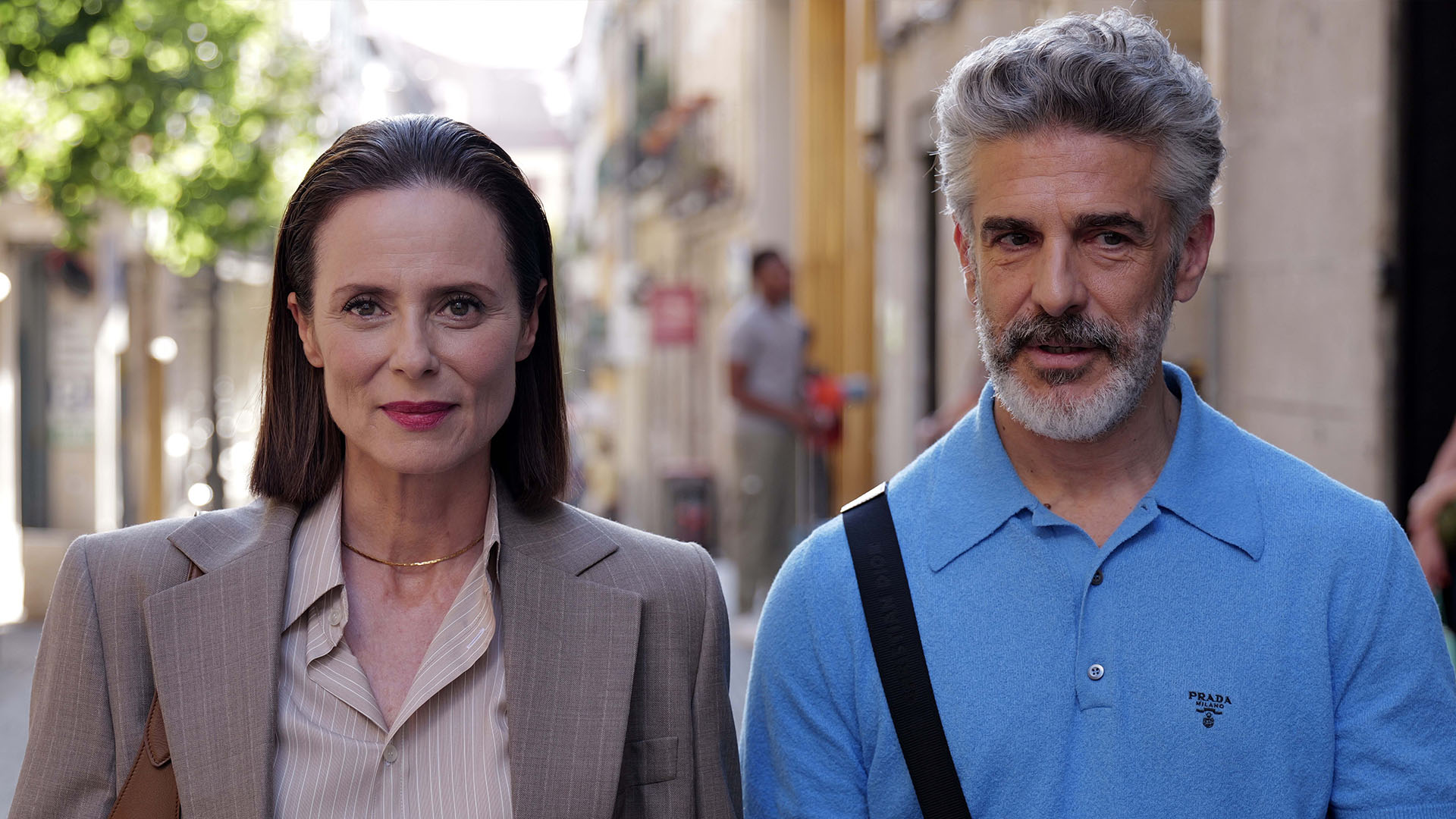
Elsa, like us, is a character. In her case, she belongs to the screenplay of Raúl (Leonardo Sbaraglia), a successful gay screenwriter who, in 2026, finally finds the motivation to write after a long creative silence. Or so he thinks. In this story about storytelling itself, Almodóvar asks whether we ever truly invent fiction, or whether everything we write is just autobiography, disguised, distorted and twice removed from reality.
As Elsa's life unfolds, its foundations are revealed in fragments. We learn how she met Beau, about her two unsuccessful films, her grief over her mother's death, the panic attacks that grief has left behind, and the friends she fears as much as she loves. Every so often, Almodóvar yanks us out of Elsa's 2004 and back into Raúl's 2026. Gradually, the mirror becomes harder to ignore. Raúl also has a younger, beautiful partner, Santi (Quim Gutiérrez). His panic attacks also began in 2004, after the death of his mother.

But the cruelest reflection is still being formed in real time. His assistant Mónica (Aitana Sánchez-Gijón) is leaving him after 20 years of work and care to look after a friend whose child is dying. As Raúl keeps writing, this present-tense sorrow begins sneaking into Elsa's world. When Elsa starts caring for a friend (Milena Smit) whose child has died, though under different circumstances, Mónica sees the theft immediately. Her friend's pain has been folded into Raúl's fiction, softened, reshaped and used. Do we own the rights to our suffering, or does grief become public property the moment someone else turns it into art?
Clues hide everywhere in Bitter Christmas. Some are as loud as the saturated colours and costumes, because this is Almodóvar and colour is never just decoration. Characters clash with their rooms, their clothes and sometimes their own emotions. Other clues are quieter, like the copy of Middlesex Elsa is reading, Jeffrey Eugenides' novel about an intersex protagonist navigating inherited identity, gender and selfhood across generations. Reporters and critics frequently noted parallels between Eugenides' life and the novel despite the author rejecting it as autobiography. The reference feels pointed here. Elsa is a woman written by a man. Raúl is a man writing himself through a woman. Almodóvar keeps layering the disguise until the disguise becomes the point.
The title comes from Chavela Vargas' song Amarga Navidad (Bitter Christmas), and her music runs through the film like an open wound. Characters sing her, listen to her and break slightly under her voice. Vargas' songs do not decorate the film. They expose it. They carry the ache of things left unsaid, things taken from life and made unbearable through performance.
You may come out of Bitter Christmas thinking, quite reasonably, what the hell did I just watch? Almodóvar remains an acquired taste. The theatrical interiors, the impossible colour schemes that resemble a David Hockney painting, all saturated primaries and artificial warmth, the frames within frames, the characters inside other characters, the emotional logic that can feel both artificial and completely naked. After his first English-language feature, The Room Next Door, he returns to Spanish with something stranger, messier and more alive.

And it is beautiful. The film moves through apartments, hospital rooms and strip clubs soaked in saturated colour before arriving at volcanic black-sand beaches where the characters' bright clothes appear almost to rebel against the landscape itself. Almodóvar's interiors are so intensely designed they seem to confess before the characters do. Sometimes the beauty feels like a crutch. Sometimes it feels like the only honest language available.
Still, Bitter Christmas works best when it embraces the mess of its own construction. Beneath the frames within frames and characters within characters lies a film fascinated by the impossibility of separating art from autobiography. Raúl writes himself through Elsa, "steals" from the people around him, disguises confession as fiction and fiction as confession. Almodóvar suggests that storytelling may simply be a more beautiful form of theft.

Director: Pedro Almodóva
Writer: Pedro Almodóvar
Production: El Deseo
Cast: Bárbara Lennie, Patrick Criado, Leonardo Sbaraglia, Quim Gutiérrez, Aitana Sánchez-Gijón, Milena Smit, Victoria Luengo, Rossy de Palma, Carmen Machi, Gloria Muñoz, Amaia Romero
Running Time: 112 minutes
Rating: 4/5


.svg)





Get weekly updates
Follow us -
@theFLICKERMAGAZINE


.png)
Join Our Newsletter
Get a weekly selection of curated articles from our editorial team.
Join Our Newsletter
Get a weekly selection of curated articles from our editorial team.