


Hit Enter to Search or X to close
Coward review: Lukas Dhont stages queer desire in the trenches
Lukas Dhont's WWI romance is visually stunning and emotionally charged, even if convention softens some of its force.
Lukas Dhont's WWI romance is visually stunning and emotionally charged, even if convention softens some of its force.









Coward review: Lukas Dhont stages queer desire in the trenches

Editor's note: Emmanuel Macchia and Valentin Campagne won the Best Actor award at the 2026 Cannes Film Festival for their performances in this film.
Lukas Dhont's Coward arrives at a moment when several European countries are once again debating the return of mandatory military service, or actively preparing to reintroduce it. After the contemporary emotional terrains of Girl and Close, Dhont turns to the First World War with questions that feel newly urgent. What does it mean to love and serve one's country, who gets asked to die for it, and who gets to call another man a coward?
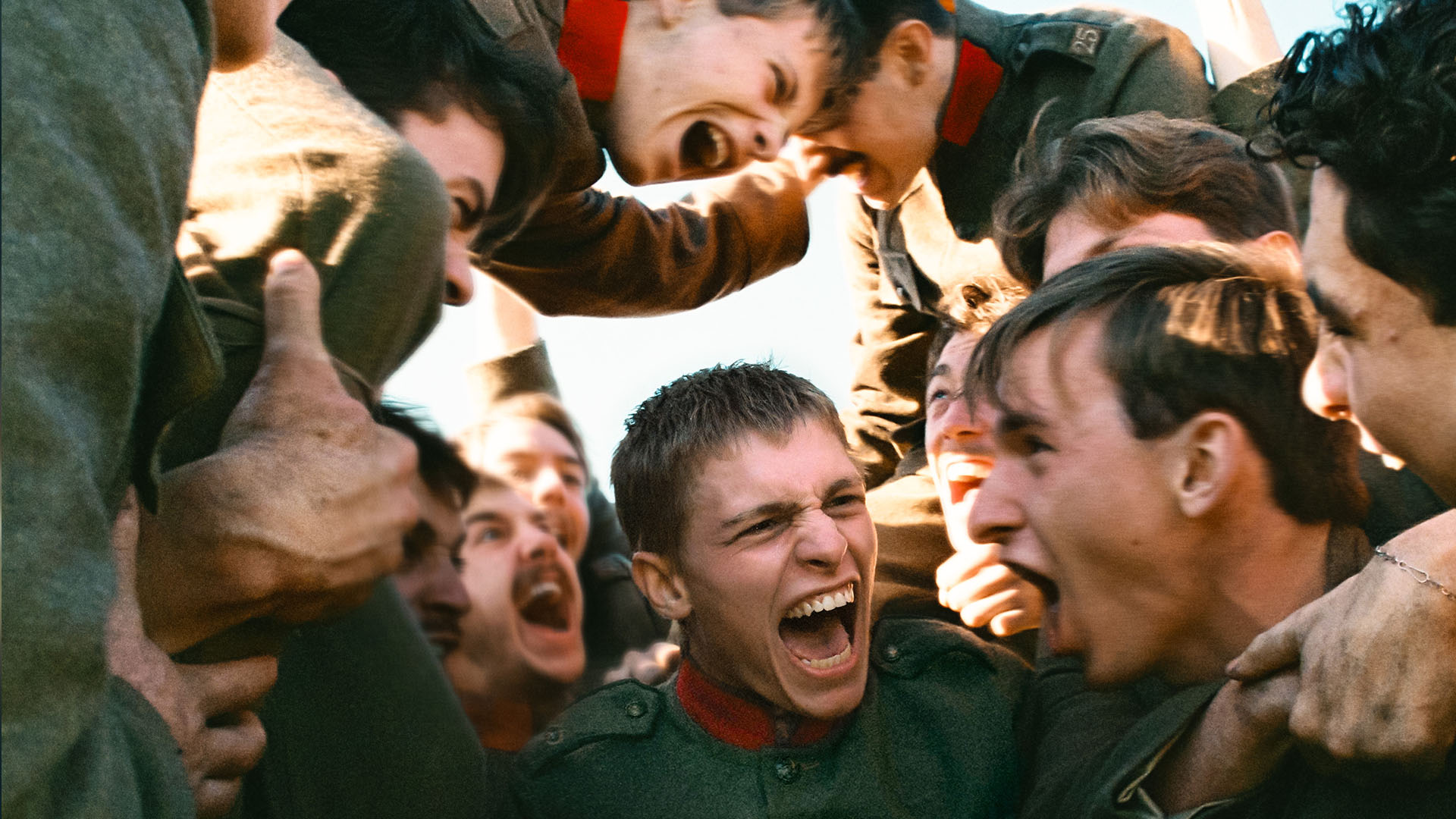
Set in Belgium during the German invasion of 1914, Coward opens with young men singing in the back of a truck as they head toward camp. At first, the mood has the careless energy of a summer outing. The destination soon reveals itself as a rudimentary military staging ground, the only thing standing between civilian life and the trenches. These men arrive with songs, jokes and bodies still unprepared for mud, blood and terror. One of them has just become a father. The celebration that follows is raucous, theatrical and faintly absurd, as if spectacle itself might hold back the coming horror.
At the centre of this opening performance is Francis (Valentin Campagne), a flamboyant young tailor who reenacts the birth of the soldier's child by playing the wife in labour. It is funny, bawdy and strangely tender, while also establishing one of Coward's sharpest ideas. The army permits queerness, performance and gender play only when they serve morale. Francis is useful as entertainment. His flamboyance is tolerated because it distracts the men from fear.
Opposite him is Pierre (Emmanuel Macchia), a quieter, more reserved farmer. When the two try to guess each other's vocations, there is already a sense that civilian identity is slipping away. They were a tailor and a farmer before they became soldiers, before the country claimed them. As Pierre helps Francis mount an improvised play for the troop, assisting with sets and costumes, the charge between them becomes unmistakable. Given Dhont's recurring interest in male intimacy, queer feeling and the violence of social codes, Coward quickly finds its emotional and sensual centre in their connection.
Dhont remains a master of light. The most beautiful shots here are bathed in the warm glow of makeshift theatre spaces, where soldiers wear costumes, sing, laugh and briefly become something other than bodies waiting to be sent forward. There is also a shaving scene of startling erotic force, with Pierre's razor travelling up Francis's thigh in a moment so intimate that the war seems, for a few seconds, to fall silent. These dreamlike sequences never remain untouched for long. The sounds of the battlefield creep in from a distance. The night trenches swallow the light. Brief truces reveal bodies of dead comrades waiting in the mud.
The strongest scenes show masculine violence encroaching on this fragile space of play. Soldiers urinate into a communal pot of soup, turning camaraderie into humiliation. A military superior gropes Pierre while he is dressed in women's clothing during a performance, a grotesque reminder that the army's tolerance of gender play depends entirely on hierarchy. Queerness is allowed as spectacle, never as freedom. Performance can amuse the men, yet it cannot protect those performing.
As Pierre and Francis pursue their attraction, the story shifts from wartime ensemble piece into doomed romance. Their differences emerge through fear. Fear of death, fear of shame, fear of desertion, fear of what courage is supposed to look like when the entire system has been built to devour young men. The title's accusation hangs over every choice. A coward may be a deserter, a lover, a survivor, or simply someone who refuses to mistake slaughter for honour.
This is also where Dhont's instincts begin to betray him. His previous work has never been afraid of extremity, though its most devastating moments often came from restraint. In Girl, the violence done to the body reverberated beyond the act itself. In Close, grief became unbearable through emotional aftermath rather than direct spectacle. Coward moves toward a more conventional shape, and that conventionality softens some of its force. A cleaner, sharper version would trust its best images and ideas enough to end earlier and more brutally. Instead, Dhont keeps pushing toward a conclusion that feels too eager to satisfy.
Even so, Coward remains visually stunning and emotionally charged, anchored by two remarkable lead performances. Campagne gives Francis both radiance and fragility, while Macchia makes Pierre's silence feel increasingly burdened by desire, fear and shame. The result does not fully escape the familiar machinery of tragic queer wartime romance, but it still finds piercing moments within it. Dhont understands the battlefield as a place where men die and where nations manufacture the language used to judge them. His subject is bravery. His real target is the cruelty of those who get to define it.

Director: Lukas Dhont
Writer: Lukas Dhont, Angelo Tijssens
Production: The Reunion, Lumen, Topkapi Films & Versus (Opus)
Cast: Emmanuel Macchia, Valentin Campagne
Running Time: 120 minutes
Award: Best Actor (Cannes Film Festival 2026) — Emmanuel Macchia, Valentin Campagne
Rating: 3/5


.svg)


.jpg)



Get weekly updates
Follow us -
@theFLICKERMAGAZINE


.png)
Join Our Newsletter
Get a weekly selection of curated articles from our editorial team.
Join Our Newsletter
Get a weekly selection of curated articles from our editorial team.