


Hit Enter to Search or X to close
Holy rebel Sergio Maggiolo on Jeezus at New Diorama Theatre London 2026
Queer comedy musical about Catholic guilt, 1990s Lima, and a boy who falls for the man on the cross. Jeezus! is Sergio Maggiolo's most personal work yet.
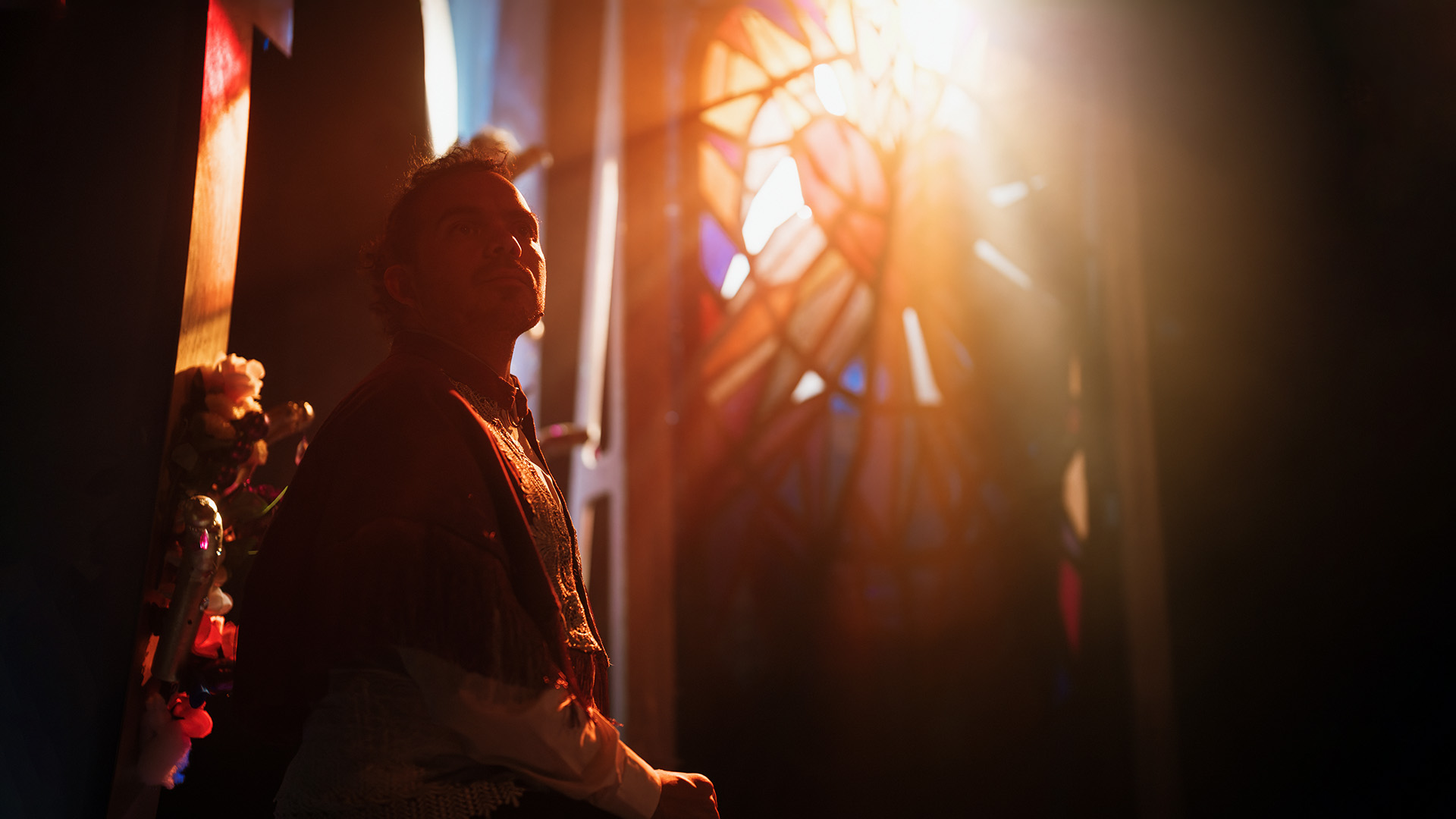
Holy rebel Sergio Maggiolo on Jeezus at New Diorama Theatre London 2026
The Peruvian-born, London-based theatre maker on writing the roles the industry won't give him, finding the divine in queerness, and why joy, right now, is a political act.
It is the opening week of Jeezus! at New Diorama Theatre and Sergio Antonio Maggiolo is stealing twenty minutes between lunch and a music rehearsal. He is speaking from the studio, and the conversation has a lightness to it that sits in interesting contrast to the show he is currently performing every night: a comedy musical that holds Catholic guilt, queer awakening, colonial mythology, and parental love in the same pair of hands.
In dark times like this, even feeling joy is an act of rebellion. A political act.
"My work and my life right now are bright, shiny and happy," he says. Then, a beat: "I feel like during the past few months I've gone through a bit of just those sad times. Not personally necessarily, because I really am privileged and grateful to be in the position that I'm in. It feels that the world is giving me and giving us tons of reasons why to be upset." He keeps going. "Trying to stay positive, trying to focus on my work and the things that are important for me and my loved ones, and also thinking about the well-being of other people and trying to spread a message of empathy and understanding. And just trying to enjoy life myself. Because I think in dark times like this, even feeling joy is an act of rebellion. A political act."
The Making of a Theatre Maker
You were born in Peru, trained in New York, and have lived in London for nearly twelve years. How did that journey shape the work you make?
"I genuinely think that America is a harder place to kick-start projects because there is not nearly as much of an incentive from the government towards the arts," Sergio says. "I feel the UK has, and you know the Arts Council for all its flaws, it really has come through for me. And not only the Arts Council but other pots of investment, from local councils, from institutions. I've been able to kick-start my projects with some money and make them grow from there."

He is glad he trained in New York rather than here, though. "I've never trained in the UK, but I also feel that a lot of people who train in the UK have not necessarily the best experience. I don't know why that is. My experience training in New York was amazing. There was a sense in American education, at least when I was there, about the positive reinforcement of what you were doing right in the creative sector. Critical feedback was always given by teachers, not students. And given with an angle of positivity. I always enjoyed that as part of the style of education."
You started out in front of a camera, not on a stage. Peruvian television, telenovelas. When did theatre properly claim you?
"I used to do film and also some telenovelas when I was out of high school, and I've always done theatre, so if anything screen was a second life," he says. "Really enjoyed it. Being in a sort of fast-paced, Latin American style, tons of people working, daily episodic telenovelas. For my first show we filmed one hundred and twenty or one hundred and thirty episodes, coming out daily." But theatre held something else, something particular. "The main reason I was drawn into theatre is the people. I've always found my tribe in theatre people. I know we can be a bit much sometimes. But I genuinely think that people who do theatre are amazing, and I really enjoy the passion that I think we feel for the work we do."
I don't feel the UK industry is ready to have immigrants as everymans. So I wrote the roles for myself.
At what point did you feel the need to start creating your own material, rather than performing other people's work?
"When people didn't ask me to work with them," he says simply.
"Going back to the previous question, New York was a much more Latino community. There were Latino plays, Latino playwrights, there were Latino characters to be played. I know that as an immigrant this is a different experience when you travel to another part of the world and you are not a neutral vessel in theatre. The everyman in Peru is somebody like me. I can play everyman in Peru, maybe in Latin America if I get the accent right. I don't necessarily feel the UK industry, or any industry really unfortunately, is ready to have immigrants as everymans."
He is matter-of-fact about it. "I went to plenty of auditions. I only go to auditions when the character is Latino. My film and screen work here has always been a Latino drug dealer or a Latino comedy silly sort of second-tier character. So the fact that I'm not going for the roles that I want to play has made me write the roles for myself and construct the project so I can perform as a protagonist in my play. And funny enough, it's made me a writer, which is great."
The Play, Jeezus! at New Diorama Theatre
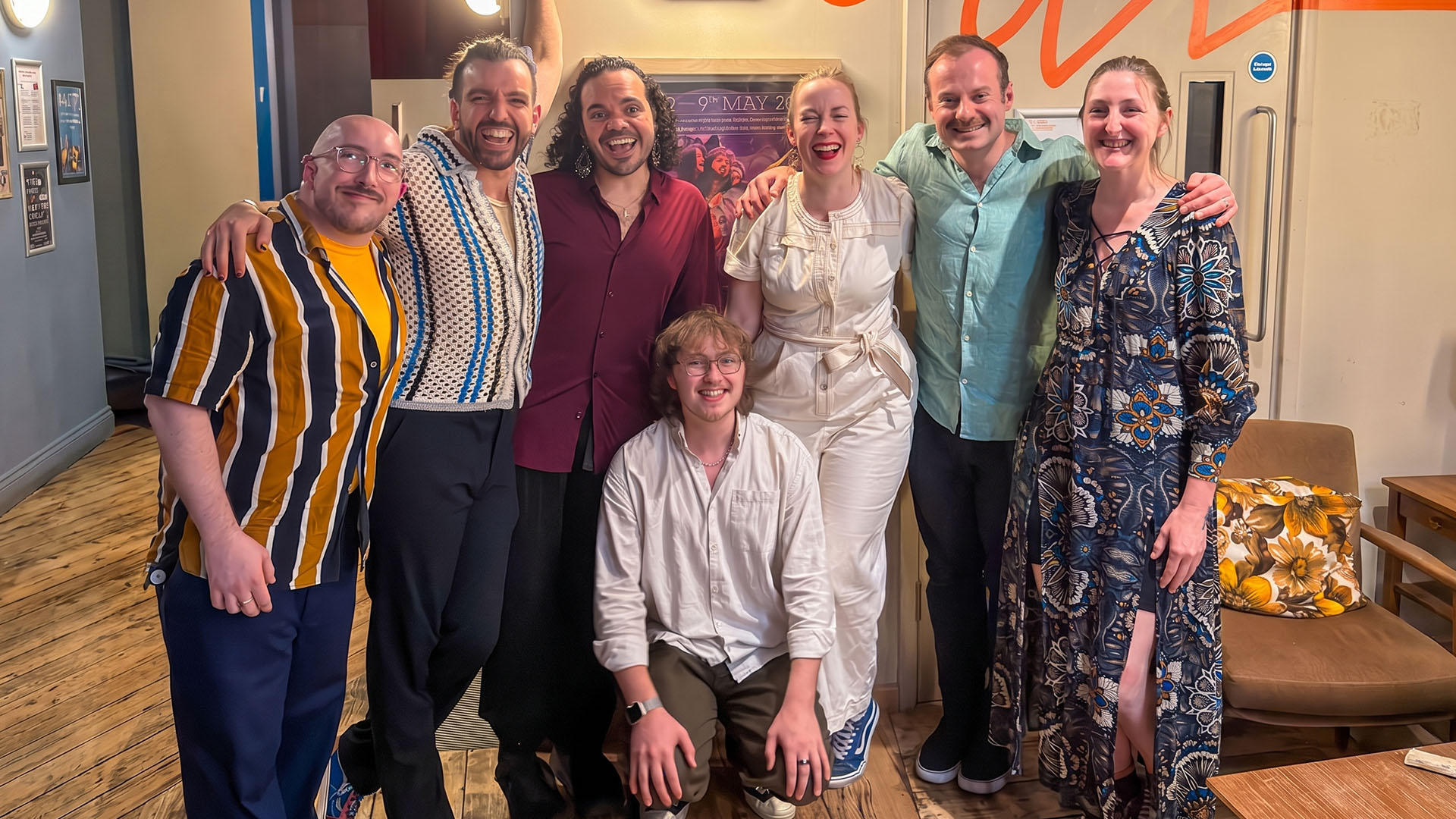
Jeezus! is set in 1990s Lima under Fujimori's dictatorship. A boy called Jesús is preparing for his first communion. The man on the cross is making him feel things that the Church would very much prefer he didn't feel. Written and performed by Sergio, with collaborator and real-life partner Guido Garcia Lueches and directed by Laura Killeen, the show won the UNTAPPED Award at Edinburgh 2025 before transferring to New Diorama for a scaled-up London premiere. Five-star reviews reached variously for "blisteringly good," "deliciously subversive," and "blasphemy has never been so much fun." It tackles colonialism, sexuality, sin, and Peruvian political history, and it does all of this inside seventy minutes of comedy musical theatre.

This show comes from something quite personal. Was there a moment where you questioned putting it out there?
"No. There's been moments after the putting it out there that I felt like, oh shit. Some angry emails from people, people justifying their violent reaction because of the poster or because of just the themes of the play. Unpleasant. But also you want to get a reaction, right."
"I don't think I've ever doubted putting it out there, thankfully. My parents came to see the show a couple of years ago when it was first in development. I was a bit nervous when they came. But they really enjoyed it, and I had the confidence to do it in front of them. They've always been so supportive. And if anyone has the right to have a problem with it, it's probably my parents, because I draw a lot from our family history. But not even. I've always been super supported by them."
You've spoken about religion as something complex in your life. How does that relationship feel now, having made this show?
"It's crazy," he says, "because I have found, during the making of this show, the importance of spirituality, not only in my mom's life and my Catholic family's life, but also in myself. I feel religion has a monopoly on spirituality which I am very keen to break apart, and also to recognise the power of the symbols that exist. It's all about semiotics at the end of the day. There's so much art that has been inspired by these stories, the stories themselves, the myths are so complex and vast, and I'm just touching the surface of the magnanimity of these themes."
He thinks about it further. "Religion is a thing that is beautiful and dark and horrifying, just an expression of humanity, which is I think the reason why it's all those things at the same time. But if anything it's drawn me closer to the magical, good, noble parts of religion, or of belief. What belief is, and how it is built, and how it connects us. I think that's a very interesting provocation, maybe for another show."
You've talked about the stories and voices you felt were missing when you were younger. What were they?
"Oh hell yeah. The obvious thing is gay-positive gay stories. I've always had this thesis that a big part of the trauma that you accumulate growing up queer is making up in your mind this idea that you have to pretend you're someone else, most importantly probably to the people you love the most. So you have to hide who you are from your parents. Creating that wall between you and the people that you love."
"It's because there wasn't any positive representation of gay people. All gay stories were traumatic, sad stories about the HIV crisis, about oppression and fighting. There wasn't the Disney prince-and-prince situation, or princess-and-princess. So yeah, that's the obvious one." He continues: "And I think the other one would be the whole monopoly of American Western white stories. They're always the good guys, they have the best PR in the world. And Jeezus! the play really screams against that."
What Comes Next
You're already percolating new work. What's on the horizon?

"Me and Guido are working on the next thing. I'm also working with my collaborator Peppa Duarte on another show. We're gonna do a gay retelling of the Gunpowder Plot, and a show about magical mushrooms that talk about underground networks of collaboration." A pause. "I have some projects that exist outside the UK, in Spain and in Peru. And I have a tour in China coming soon. It'll be my third time taking work to China so really excited about that."
And Jeezus! itself? "There's a specific moment I always love to perform, and it's about a little lamb. I don't want to ruin it." Then: "I look forward to the moment that this show is on Broadway."
Jeezus! runs at New Diorama Theatre until 9 May 2026.
Tickets: https://newdiorama.com/whats-on/jeezus
Content warning: sexual content, strong language including homophobic language. Age guidance 16+.

.svg)


Get weekly updates
Follow us -
@theFLICKERMAGAZINE


.png)
Join Our Newsletter
Get a weekly selection of curated articles from our editorial team.
Join Our Newsletter
Get a weekly selection of curated articles from our editorial team.